The Retro-Chic Stories of Shirley Jackson: A Review Of Come Along With Me
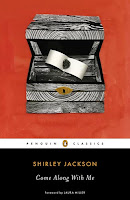
I wanted to read Come Along With Me: Classic Short Stories and An Unfinished Novel, by Shirley Jackson, for multiple reasons. The first reason was that I'd read a few critical articles that described Jackson (who wrote most of her work during the 1950's) as a sort of proto-second-wave feminist: someone who smuggled subversive visions of women's secret inner turmoils into the pages of bourgeois magazines like The New Yorker and Mademoiselle. Since I'm a young woman who's interested in feminism - and since I'm a poet and short-story-writer myself - I was hoping that Jackson's writing would inspire me, or even influence me.
The second reason that I wanted to read Come Along With Me, though, was that I thought the stories in it were all going to be spooky. I hadn't read any of Jackson's short stories before, but I had read her 1959 novel The Haunting Of Hill House. I'd loved that book, and considered it to be one of the few truly eerie and haunting ghost stories that I'd ever read. Besides that, I'd heard of - but hadn't worked up the courage to actually read - We Have Always Lived In The Castle, the sinister tale of a fierce wild girl living alone with her sister in a rambling creepy old house. So when I heard about Come Along With Me - a collection that included sixteen short stories, plus two essays on writing and the titular unfinished novel "Come Along With Me" - I jumped at the chance. I was hoping for a whole book of stories about ghosts and haunted houses and wild witch-girls with weird powers, or failing that, for a raft of stories about the secret horror of '50's suburbia, about housewives going mad and things like that.
Well, maybe I was misinformed; maybe I picked the wrong story collection (maybe I should have picked The Lottery and Other Stories, which was the one collection published during Jackson's lifetime, instead; maybe that would have been scarier), or maybe the critics were wrong about her, but I felt like I'd asked for Eye of Newt and ol' Shirley had given me Waldorf Salad. With the exception of "Come Along With Me" itself - the tale of Angela Motorman, a tough-talking eccentric woman who can communicate with ghosts (a story that suffers from being uncompleted: Jackson intended it to be a novel, but died before she could finish writing it, so readers never find out where Angela's powers lead her) - the stories in Come Along With Me aren't really spooky or supernatural at all. Quite a few of them - most memorably "Tootie In Peonage" (in which a rich snobbish woman is driven to distraction by the crazily ditzy inept "backwoods" girl she's hired as a housekeeper), "The Pajama Party" (a true story, wherein Jackson recounts a birthday-party fiasco) and "A Cauliflower In Her Ear" (a tight little gem of a tale, so tight that to attempt a summary would spoil it) - are outright comical. A couple of them - "Janice" and "I Know Who I Love", both dealing with small sad young women oppressed by their families - are so sad that I don't recommend reading them when you're feeling sad or self-pitying yourself, because they'll only make you feel worse. Most of the others - most memorably "The Beautiful Stranger" and "Island" - are examples of straight domestic realism, a genre I've never particularly cared for.
I must confess, I was a wee bit disappointed by the lack of supernatural spookiness. But once I'd adjusted my expectations and resolved to judge the stories on their own merits, I found that they were quite good. Jackson is a good prose writer, with a crisp, witty style reminiscent of Dorothy Parker and James Thurber (two writers who, in the '20's and '30's, wrote for an earlier version of the same New-Yorker-magazine audience that Jackson wrote for in the '50's) . Besides that, her stories have the glamour of a bygone. These are posh stories, intended for a posh audience: with few exceptions, the characters in them wear mink coats, shop at exclusive department stores, and own apartments in New York and summer homes in New Hampshire. While I sometimes found the pervasive poshness of the settings and characters to be rather stifling, I suspect that many readers will find the retro-chic quality of these stories fascinating in its own right. I'll admit, I myself was fascinated by the small but detailed glimpses of the past that these stories provided.
In conclusion, while I found Shirley Jackson to be less of a feminist and less of a horror-story queen than I had hoped, I consider Come Along With Me to be a worthwhile read. I recommend it to fans of James Thurber, Dorothy Parker, and Mad Men, as well as to anyone looking for sharp, funny short stories.
The second reason that I wanted to read Come Along With Me, though, was that I thought the stories in it were all going to be spooky. I hadn't read any of Jackson's short stories before, but I had read her 1959 novel The Haunting Of Hill House. I'd loved that book, and considered it to be one of the few truly eerie and haunting ghost stories that I'd ever read. Besides that, I'd heard of - but hadn't worked up the courage to actually read - We Have Always Lived In The Castle, the sinister tale of a fierce wild girl living alone with her sister in a rambling creepy old house. So when I heard about Come Along With Me - a collection that included sixteen short stories, plus two essays on writing and the titular unfinished novel "Come Along With Me" - I jumped at the chance. I was hoping for a whole book of stories about ghosts and haunted houses and wild witch-girls with weird powers, or failing that, for a raft of stories about the secret horror of '50's suburbia, about housewives going mad and things like that.
Well, maybe I was misinformed; maybe I picked the wrong story collection (maybe I should have picked The Lottery and Other Stories, which was the one collection published during Jackson's lifetime, instead; maybe that would have been scarier), or maybe the critics were wrong about her, but I felt like I'd asked for Eye of Newt and ol' Shirley had given me Waldorf Salad. With the exception of "Come Along With Me" itself - the tale of Angela Motorman, a tough-talking eccentric woman who can communicate with ghosts (a story that suffers from being uncompleted: Jackson intended it to be a novel, but died before she could finish writing it, so readers never find out where Angela's powers lead her) - the stories in Come Along With Me aren't really spooky or supernatural at all. Quite a few of them - most memorably "Tootie In Peonage" (in which a rich snobbish woman is driven to distraction by the crazily ditzy inept "backwoods" girl she's hired as a housekeeper), "The Pajama Party" (a true story, wherein Jackson recounts a birthday-party fiasco) and "A Cauliflower In Her Ear" (a tight little gem of a tale, so tight that to attempt a summary would spoil it) - are outright comical. A couple of them - "Janice" and "I Know Who I Love", both dealing with small sad young women oppressed by their families - are so sad that I don't recommend reading them when you're feeling sad or self-pitying yourself, because they'll only make you feel worse. Most of the others - most memorably "The Beautiful Stranger" and "Island" - are examples of straight domestic realism, a genre I've never particularly cared for.
I must confess, I was a wee bit disappointed by the lack of supernatural spookiness. But once I'd adjusted my expectations and resolved to judge the stories on their own merits, I found that they were quite good. Jackson is a good prose writer, with a crisp, witty style reminiscent of Dorothy Parker and James Thurber (two writers who, in the '20's and '30's, wrote for an earlier version of the same New-Yorker-magazine audience that Jackson wrote for in the '50's) . Besides that, her stories have the glamour of a bygone. These are posh stories, intended for a posh audience: with few exceptions, the characters in them wear mink coats, shop at exclusive department stores, and own apartments in New York and summer homes in New Hampshire. While I sometimes found the pervasive poshness of the settings and characters to be rather stifling, I suspect that many readers will find the retro-chic quality of these stories fascinating in its own right. I'll admit, I myself was fascinated by the small but detailed glimpses of the past that these stories provided.
In conclusion, while I found Shirley Jackson to be less of a feminist and less of a horror-story queen than I had hoped, I consider Come Along With Me to be a worthwhile read. I recommend it to fans of James Thurber, Dorothy Parker, and Mad Men, as well as to anyone looking for sharp, funny short stories.

Comments
Post a Comment